Exploit Validation
Prove what is actually reachable
Prioritize evidence over noise. HEXBOX validates exploitable paths so teams act on the risks that matter.
Know which exposures can be exploited. Give engineers reproducible proof, prioritize remediation, and verify that each fix holds.
Request a security brief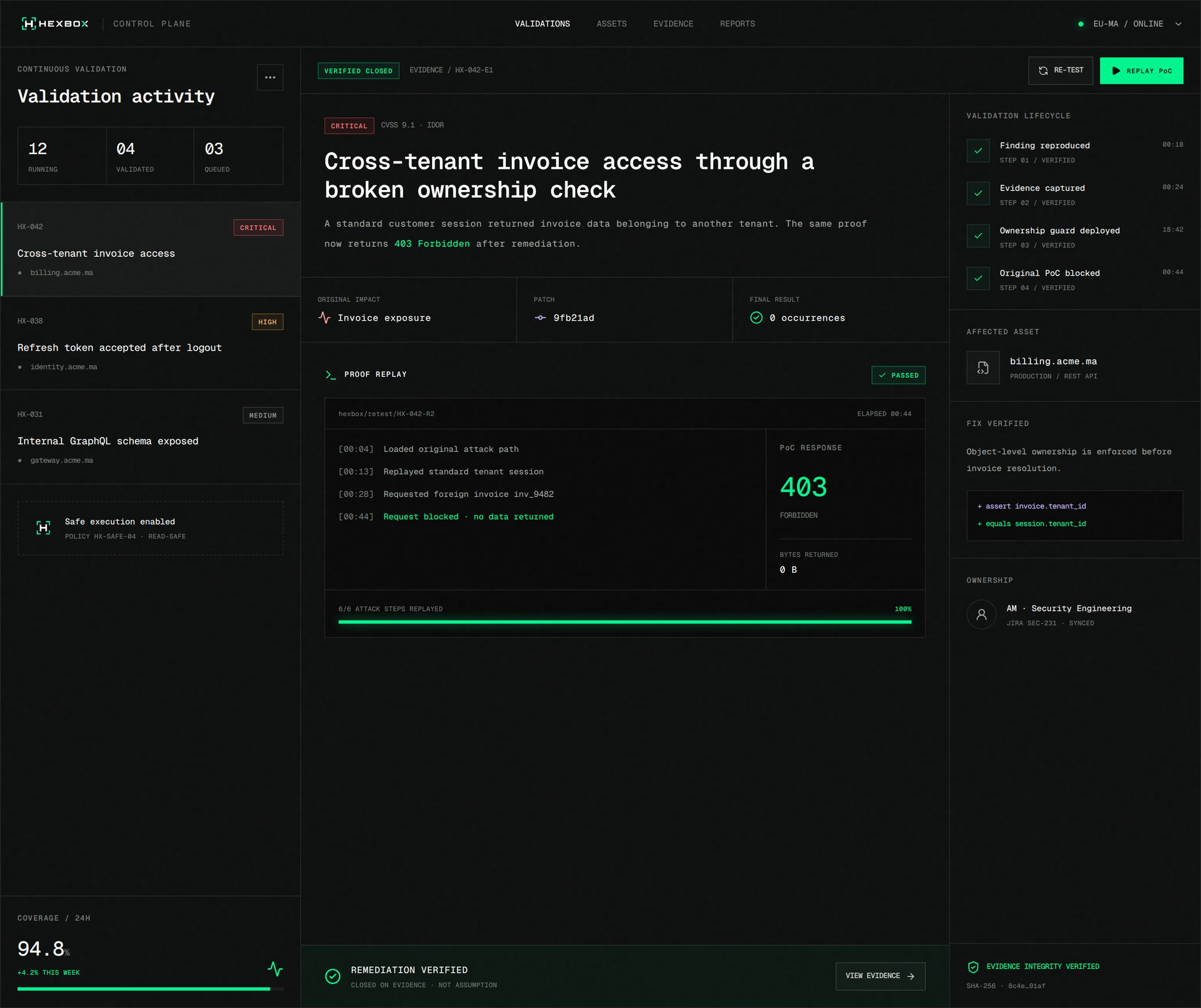
Validation across your attack surface
[CAPABILITIES]
Exploit Validation
Prioritize evidence over noise. HEXBOX validates exploitable paths so teams act on the risks that matter.
Evidence Trails
Capture reproducible steps, impact, and technical context for security teams and engineering owners.
Continuous Retesting
Turn remediation into a measured loop: confirm closure and retest as your attack surface changes.
[VALIDATION LOOP]
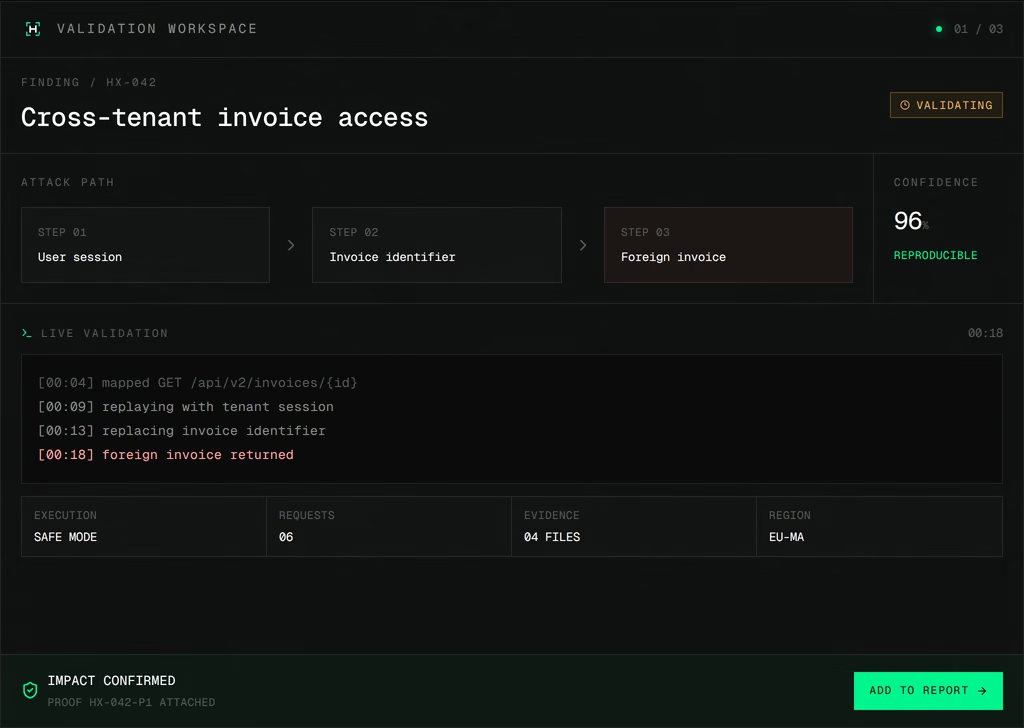
We don’t flood your team with theoretical alerts. HEXBOX reproduces and validates findings before they appear in the report, ensuring that every issue is tied to a real and demonstrated security risk.
[HOW IT WORKS]
Define assets, endpoints, credentials, techniques, limits and exclusions.
Automated offensive workflows discover, test and validate real attack paths in isolated environments.
Receive evidence-backed findings, impact, severity and remediation guidance, without the noise.
[INSIDE HEXBOX]
A workflow overview: coordinate the work, isolate execution, and validate results before they reach your team.
Plans, delegates, and tracks work within the agreed scope.
Maps the surface and gathers context.
Investigates relevant attack paths.
Replays checks after remediation.
Reproduce the result. Check the impact. Capture the evidence.
[WHY HEXBOX]
Move beyond periodic engagements with a validation loop that tracks your real attack surface.
Validation is designed around controlled execution, isolation, and explicit security boundaries.
Every validated issue comes with practical context your team can inspect and reproduce.
Give engineering the proof, the impact, and the steps needed to resolve the right risk.
Verify that the remediation holds after releases, infrastructure changes, and new exposures.
Serious offensive-security capability, created in Morocco for organizations across Africa, MENA, and Europe.
[GUARDRAILS & MOROCCAN CONTEXT]
The decisions to agree before every engagement, alongside your security, legal, and data-protection teams.
Agree the permitted assets, exclusions, and accountable owners in writing before testing starts.
Agree test windows, load limits, permitted techniques, and stop conditions.
Define necessary permissions, environment isolation, and credential lifecycles.
Agree data minimization, authorized recipients, retention, and deletion.
Connect each finding to its scope, supporting evidence, and retest outcome.
Identify contacts, an escalation channel, and a stop procedure before execution.
Scope the engagement around applicable personal-data obligations: purpose, access, retention, and CNDP formalities. Review cross-border transfers before choosing where evidence is hosted or who receives it.
CNDP guidanceCross-border transfersFor entities in scope and sensitive information systems of critical infrastructure, assess Law 05-20 and its implementing requirements. Continuous validation does not replace a regulated audit that requires a DGSSI-qualified provider.
DGSSI guidanceApplicable requirements depend on your organization and the proposed processing. These scoping considerations are not a certification or a guarantee of compliance.
Discuss your scope[YOUR DELIVERABLES]
Understand what is exposed, which path was validated, and why it matters to your business.
Give engineering the requests, responses, and reproduction steps needed to investigate with confidence.
Turn a security finding into a clear engineering task with practical context and a defined fix path.
Check the same attack path after remediation and document whether the original exploit still works.
Keep a record of validated findings and retest outcomes as your applications and infrastructure change.
[ENGAGEMENTS]
Start with a focused assessment of your attack surface, validated exposure, and security priorities.
Discuss your scopeFor teams that need an ongoing security-validation loop with evidence, remediation context, and retesting.
Join the pilot[FAQ]
Web applications, APIs, identities, cloud exposure, and the attack paths connecting them — within an explicitly agreed scope.
No. Scanners surface possibilities. HEXBOX safely validates whether a path is genuinely exploitable and records the proof.
We monitor agreed surfaces, validate meaningful changes, deliver evidence, and retest fixes on a defined cadence.
Every engagement uses explicit scope, controls, limits, isolation, and a documented stop process.
Security and engineering teams that need stronger prioritization, reproducible proof, and verified remediation.
HEXBOX is built in Morocco and works with organizations across Africa, MENA, and Europe.
[YOUR NEXT STEP]
Make offensive security continuous, evidence-driven, and ready to act on.
Talk to HEXBOXTell us about your assets, priorities, and the scope you want to validate.