
Subdomain takeover: when an old CNAME becomes a way in
Lire en français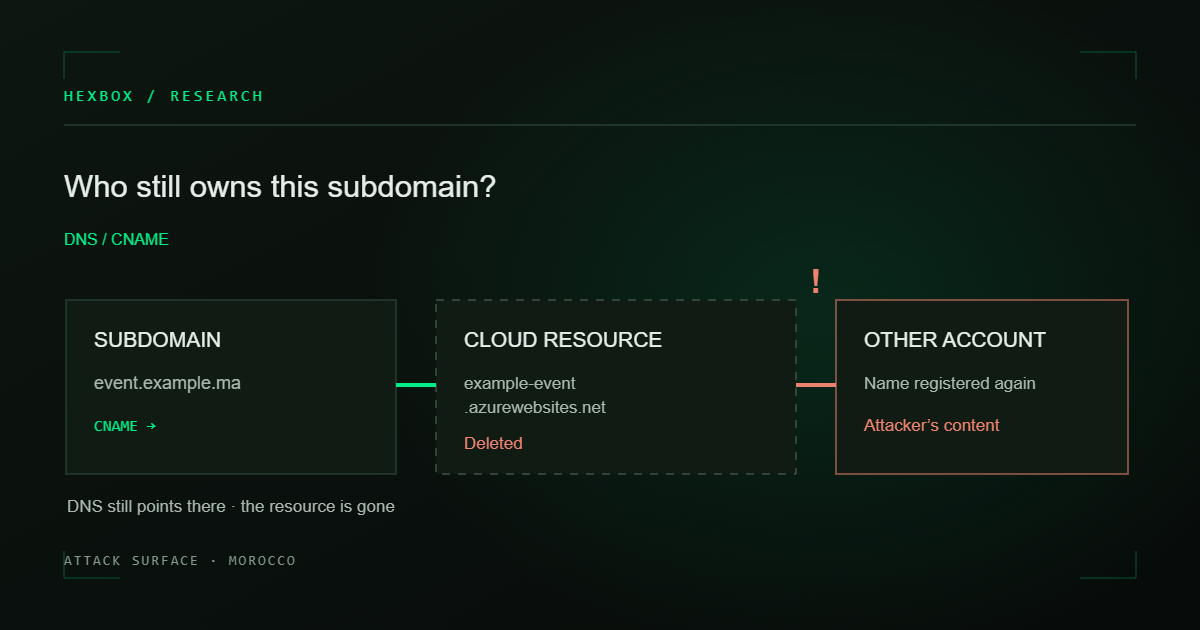
A CNAME record pointing to a deleted cloud service is enough for an attacker to publish on your domain. How to spot it and fix it.
Table of contents
A marketing campaign that ended, an abandoned staging site, an application moved to another host. The cloud resource was deleted, but the DNS record stayed. For an attacker, that forgotten subdomain can be enough to publish whatever they want at an address that carries your name.
Subdomain takeover in brief
| Cause | A DNS record points to a third-party resource that no longer exists |
| Condition | The provider lets anyone create a resource with the same name again |
| Impact | Arbitrary content served under your domain, cookie theft, convincing phishing |
| Effort for the attacker | Low, often a free account with the provider |
| Fix | Remove the DNS record, or reclaim the resource |
How it happens
Take a realistic example. Your team launches a site for an event, hosted on Azure. It creates this subdomain:
event.example.ma. CNAME example-event.azurewebsites.net.The event ends. Someone deletes the Azure app to cut the bill. Nobody thinks about DNS, which is handled by another team or an outside provider.
From then on, example-event.azurewebsites.net is a free name. An attacker creates an Azure app with that name, adds event.example.ma as a custom domain, and your DNS does the rest: visitors to event.example.ma land on their content.
Nothing was hacked in the usual sense. No flaw in your code, no stolen password. It is an inventory mistake.
What an attacker can do with it
The danger comes from the trust that browsers, your customers and your own applications place in your domain.
- Phishing: a fake login page on
event.example.mais far more convincing than an unknown domain, and mail filters often let it through. - Session theft: if your session cookies are set for
.example.ma, the browser also sends them to the taken-over subdomain, where the attacker can collect them. - Bypassing security rules: a CORS or CSP policy that trusts
*.example.ma, or an overly broad OAuth redirect URL, now accepts a server the attacker controls. - Reputation damage: illegal or advertising content under your name, reported by your customers before you notice.
Good practice. Staging and campaign subdomains are the most exposed. They are created quickly, by different teams, and rarely removed cleanly.
The services most often involved
The risk depends on how each provider verifies domain ownership. Some have tightened their rules in recent years, others remain exploitable. The most common in our analyses:
| Service | Typical CNAME target | Sign of a deleted resource |
|---|---|---|
| Azure App Service | *.azurewebsites.net |
The name no longer resolves (NXDOMAIN) |
| AWS S3 | *.s3.amazonaws.com |
"NoSuchBucket" error page |
| GitHub Pages | *.github.io |
GitHub 404 page |
| Heroku | *.herokuapp.com |
"No such app" page |
| SaaS platforms (shops, help desks, landing pages) | Provider-specific name | Page saying the site does not exist |
An error message like these does not prove on its own that the subdomain can be taken over. You need to check, provider by provider, whether a third party can actually register the name.
How to check your subdomains
Start by listing your CNAME records. If you have access to your DNS zone, export it. Otherwise you can query a specific subdomain:
dig +short CNAME event.example.maThen check that the target still exists:
dig +short example-event.azurewebsites.net
curl -sI https://event.example.ma
A target that no longer answers, or returns the provider’s error page, deserves an immediate look.
The hard part is the inventory. A mid-sized company often has dozens of subdomains, some of them created by agencies or former contractors. Certificate Transparency logs and public DNS datasets often reveal names the internal team had forgotten. Attackers use exactly these sources.
Fix it and keep it from coming back
For a vulnerable subdomain:
- Remove the DNS record if it is no longer used. This is the safest fix.
- If the subdomain must stay, recreate the resource with the provider under your own account, then attach it properly.
- If a takeover may have happened, treat the domain’s cookies as exposed: force active sessions to log out.
To keep it from coming back:
- reverse the decommissioning order: DNS first, then the resource;
- keep an inventory of subdomains with an owner for each;
- scope cookies to the subdomain that needs them rather than the whole domain;
- watch for new subdomains and for CNAMEs that point to third-party services.
At HEXBOX, attack surface mapping flags subdomains that point to third-party services. A suspicious CNAME remains a signal until it is verified. During a test, we confirm whether the resource can really be taken over, without claiming it ourselves, then we verify the fix.
SPF, DKIM, DMARC: can your domain be spoofed by email?
SPF, DKIM and DMARC explained plainly, with the commands to check in two minutes whether your domain can be spoofed by email.
HEXBOX4 min read
PHP2Shell: Critical PHP Vulnerabilities (CVE-2026-109618, CVE-2026-109619)
PHP2Shell: two critical (CVSS 9.2) flaws in the PHP runtime may allow unauthenticated RCE. Affected versions, expected fixes and what to do right now.
HEXBOX5 min read

Penetration Testing in Morocco: A Guide for Companies
How Moroccan companies can prepare, scope, and get value from a penetration test: authorization, evidence, retesting, and budgeting in MAD.
HEXBOX2 min read